2007 Toyota Tacoma Alternator fuse location
This Tacoma has 2 different fuse boxes where the alternator fuse is located:
Engine compartment
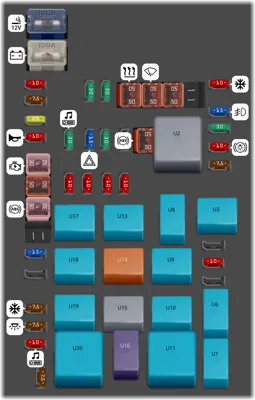
Fuses and relays related to the alternator:
| Type | No. | Description | |
|---|---|---|---|
Fuse FLF/PAL 293 120A | 48 | (ALT) [without towing package] "AM1", "AC SKT", "HEATER", "FR FOG", "STOP", "OBD", "J/B", "TOWING TAIL", "TOWING BRK", "BATT CHG"
140 AMP (ALT) [with towing package] "AM1", "AC SKT", "HEATER", "FR FOG", "STOP", "OBD", "J/B", "TOWING TAIL", "TOWING BRK", "BATT CHG" | |
| ... hay otros 54 fusibles no mostrados ... | |||
Instrument panel
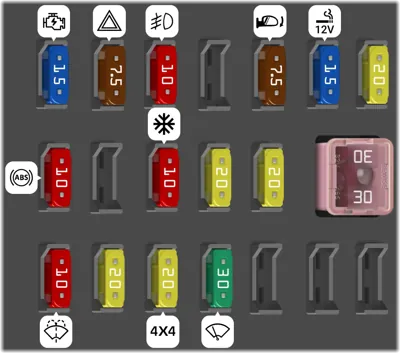
Fuses and relays related to the alternator:
| Type | No. | Description | |
|---|---|---|---|
Fuse MINI 10A | 31 | (IG1 NO.2) Anti-lock brake system, vehicle stability control system stop lights, charging system, multiport fuel injection system/sequential multiport fuel injection system, air conditioning system, instrument panel light control, clutch start cancel switch, rear differential lock system, power outlets, tire pressure warning system | |
| ... hay otros 19 fusibles no mostrados ... | |||
Why does the alternator fuse blow in the Tacoma?
The most common reasons for the alternator fuse blowing are:
- Short circuit in the wiring: a short circuit in the cables connecting the alternator to the battery or other electrical components can cause excessive current flow, which makes the fuse blow to protect the system. This can be caused by frayed, damaged wires or wires in contact with metal parts.
- Faulty alternator: if the alternator is damaged or has an internal failure, such as a short circuit in the winding or the diodes, it can cause an increase in current draw, which will blow the fuse.
- Current overload: if the alternator is overloaded because it has to supply too much power (due to a heavily discharged battery or excessive electrical consumption in the vehicle), the fuse may blow to protect the system.
- Incorrect fuse: if the installed fuse has a lower amperage than specified by Toyota, it can easily blow under normal system load. The fuse should be designed to handle the alternator's current flow.
- Voltage regulator problems: the voltage regulator controls how much electricity the alternator sends to the battery. If the regulator is faulty and allows the alternator to send excessive voltage, it can overload the system and blow the fuse.
It is important to find and fix the cause of the overload before replacing the fuse. Checking the wiring, connections and associated electrical components is essential to avoid blowing the new fuse once it is replaced.
Other causes of alternator failure in the Tacoma
The same causes mentioned above can result in alternator malfunctions in addition to blowing the fuse. If the alternator fuse is not blown, here are other possible causes of failure:
- Damaged or loose alternator belt: if the belt that drives the alternator is worn, broken, or loose, the alternator will not be able to turn and generate electricity. This problem is mechanical, not electrical, but directly affects the alternator's operation.
- Faulty voltage regulator: the voltage regulator controls how much energy the alternator supplies to the battery. If the regulator is damaged, it may cause the alternator to produce insufficient energy or, in some cases, not function at all.
- Battery problems: if the battery is faulty or not holding a charge, the alternator may be working correctly, but the energy will not be stored. This can give the impression that the alternator is not working, even though the problem lies with the battery.
Common issues with the Alternator fuse
Airbag light came on. Where is the fuse for it?
Toyota Tacoma 2008 Tacoma
The battery light came on. We changed the battery, alternator and belt. 2 days layer the airbag light came on. It has 340,000 miles and the dealership won't touch it. Help! Just wanna remove the fusea…

Fusebox diagram and what they do? Need to find the Secondary air
Toyota Tacoma 2008 Truck
Injection System Relay A Circuit and what kind of fuse do I need?
Fuse for anti theft
Toyota Tacoma 2006
What fuse is for the anti theft on an 2006 Toyota tacoma and where is it located
Radio does not come on, fuse is good
Toyota Tacoma 2008 tacoma 4cyl base model
Radio was working when I shut the truck off. When I started it again I have nothing. Everything else works. I only seem to have one fuse for the radio and it is good.
Efi no. 2 fuse no power to fuse. Also obd11 has no power.
Toyota Tacoma 2006 Double cab 4.0 4x4
No power going to fuel pump, checked all fuses and relays. Cranks over but no start.
Still have doubts about your issue?
Ask the community!
Ask the community!


