2016 Hyundai Elantra Gen6 Sedan Fuel pump fuse location
Engine compartment
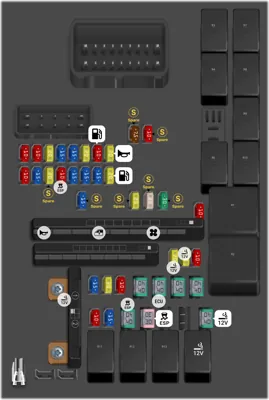
Fuses and relays related to the fuel pump:
| Type | No. | Description | |
|---|---|---|---|
Multi fuse block MUSB | 3 | PCB Block (Fuse : ECU3, ECU4, HORN, FUEL PUMP, ENGINE CONTROL RELAY) | |
Fuse MICRO2 10A | 34 | Oil Control Valve #1/#2/#3, Electronic Thermo Sensor, Fuel Pump Relay | |
Fuse MICRO2 20A | 43 | Fuel Pump Relay | |
| ... hay otros 72 fusibles no mostrados ... | |||
Why does the fuel pump fuse blow in the Elantra?
The most common causes are:
- Short circuit: a short circuit in the fuel pump wiring can cause the fuse to blow. This can be due to damaged, frayed, or exposed wires coming into contact with the vehicle’s body.
- Damaged fuel pump: if the fuel pump is failing or nearing the end of its life, it may draw more current than usual, which can overload the fuse.
- Clogged fuel filter: if the fuel filter is severely clogged, the pump may work harder than normal to supply fuel, resulting in excessive current draw and causing the fuse to blow.
- Incorrect fuse usage: if the fuel pump fuse has been replaced with one that has a lower amperage rating than specified by Hyundai, it is more likely to blow under normal operating conditions.
If the fuel pump fuse is blown, it’s important to identify and fix the cause of the overload before replacing it, to prevent the new fuse from blowing as well.
Other causes of fuel pump failure in the Elantra
If the fuel pump fuse is not blown, other possible causes of failure include:
- Defective fuel pump relay: the relay controls the power supply to the pump. If this component fails, the pump will not receive power and will not operate.
- Activated impact sensor: some vehicles have an impact sensor, also called an inertia switch, that cuts off power to the fuel pump in the event of a crash. If this sensor is accidentally triggered, the pump will stop working.
- Engine Control Unit (ECU) problems: the ECU controls many functions in the vehicle, including the operation of the fuel pump. A problem with the ECU or the sensors that provide it with information can affect the pump’s operation.
- Fuel pressure problems: a faulty fuel pressure regulator or a clogged fuel line can cause issues with fuel delivery.
- Other causes: as mentioned earlier in the case of the fuse, a defective fuel pump, wiring issues, or a clogged fuel filter can cause the fuel pump to stop working, even if the fuse is not blown.
To diagnose the problem, it’s helpful to check if power is reaching the pump during startup. If there is power but the pump doesn’t work, the pump is likely faulty. If there’s no power, the issue is likely electrical or with the ECU.
Common issues with the Fuel pump fuse
Horn isn't working
Hyundai Elantra 2016 GT
The horn doesn't work, I changed the fuse and it still transmits electricity but the horn doesn't work. I put a new one on it and it doesn't work either. What's the problem?

Code fuse on
Hyundai Elantra 2015 Sedan
I would like to know what it means when my car is flashing fuse on
Where is the fuse for the dimmer switch my dimmer switch does nothing
Hyundai Elantra 2017 Se 4 dr 2.o liter
My dimmer switch does nothing at all it won't dim or brighten the interior lights
Motor of left hand mirror always running
Hyundai Elantra 2015 Sedan
Its annoyed me by its noise, I remove the plug of mirror, after failed to reach fuse of mirror motor
Stereo won’t work
Hyundai Elantra 2015 4DR Elantra, Sedan
Radio has power, all other accessories work functionally (clock, chargers, etc) but no sound. When I turn the car on, I can hear a “thump” which I read that it’s the amplifiers getting power. I checke…
Still have doubts about your issue?
Ask the community!
Ask the community!


