2007 Toyota FJ Cruiser Cigarette lighter fuse location
This FJ Cruiser has 3 different fuse boxes where the cigarette lighter fuse is located:
Engine compartment 1
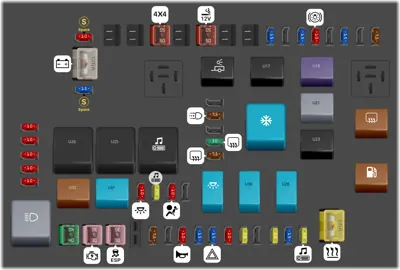
Fuses and relays related to the cigarette lighter:
| Type | No. | Description | |
|---|---|---|---|
Fuse FMX/JCase 50A | 40 | (J/B) "TAIL", "PWR OUTLET", "POWER" | |
| ... hay otros 66 fusibles no mostrados ... | |||
Engine compartment 2

Fuses and relays related to the cigarette lighter:
| Type | No. | Description | |
|---|---|---|---|
Fuse FMX/JCase 80A | 45 | (AC 115V) Power outlet | |
| ... hay otros 1 fusibles no mostrados ... | |||
Instrument panel
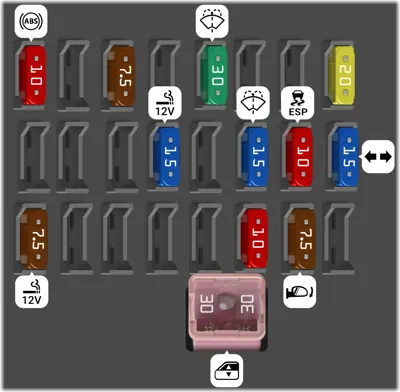
Fuses and relays related to the cigarette lighter:
| Type | No. | Description | |
|---|---|---|---|
Fuse MINI 15A | 32 | (PWR OUTLET) Power outlet | |
Fuse MINI 15A | 35 | (IG1) Turn signal lights, air conditioning system, charging system, clutch start cancel switch, anti-lock brake system, traction control system, activtraction control system, vehicle stability control system, "AUTO LSD" system, back-up lights, intuitive parking assist, rear differential lock system, power outlet, accessory meter, meter and gauge | |
Fuse MINI 7.5A | 36 | (STA) Starting system, clutch start cancel switch, power outlet | |
Fuse MINI 7.5A | 38 | (ACC) Shift lock system, outside rear view mirrors, audio system, power outlet, clock, accessory meter, multiplex communication system | |
| ... hay otros 21 fusibles no mostrados ... | |||
Why does the cigarette lighter (power socket) fuse blow in the FJ Cruiser?
The most common reasons for the cigarette lighter (or power socket) fuse blowing are:
- Current overload: connecting devices that draw more current than the fuse is designed to handle (such as high-power chargers, air compressors, power inverters, etc.) can cause the fuse to blow. Cigarette lighter sockets are designed for a limited load, and devices exceeding this capacity can cause an overload.
- Short circuit: a short circuit can occur if the lighter or socket has damaged, frayed wires or wires in contact with metal parts. This can cause excessive current flow and blow the fuse as a protective measure.
- Using faulty adapters: some low-quality or defective adapters or chargers may have internal problems that cause a short circuit or excessive current consumption, which overloads the system and blows the fuse.
- Incorrect fuse: if a fuse with a lower amperage than recommended by Toyota has been installed, it may blow quickly when the lighter or connected accessories are used.
Other causes of cigarette lighter (power socket) failure in the FJ Cruiser
In addition to a blown fuse, here are other common causes that can prevent the cigarette lighter from working:
- Defective or damaged lighter: if the lighter itself (or the accessory adapter) is defective or worn, it may not work properly. The heating element inside the lighter could be damaged, or the internal parts may be broken.
- Damaged lighter socket: the socket where the lighter or accessories are plugged in could be damaged. If the contacts inside the socket are worn or bent, there won’t be a proper connection for the lighter to function.
- Wiring issues: the wiring that connects the lighter socket to the vehicle's electrical system may be damaged, broken, or loose, interrupting the flow of current to the lighter.
- Problems with the connected device: sometimes the issue may lie with the device you're trying to use, such as a defective charger or adapter. If the device is damaged, it may seem like the lighter socket isn’t working, but the problem is actually with the device.
Common issues with the Cigarette lighter fuse
Lighting Internal
Toyota FJ Cruiser 2014
I have a problem with ceiling lighting, it was completely successful, and it was confirmed that the fuses are working and the bulbs are also working before

Still have doubts about your issue?
Ask the community!
Ask the community!


Find what you needed?
Thank you!

